
Research
Projects and reports
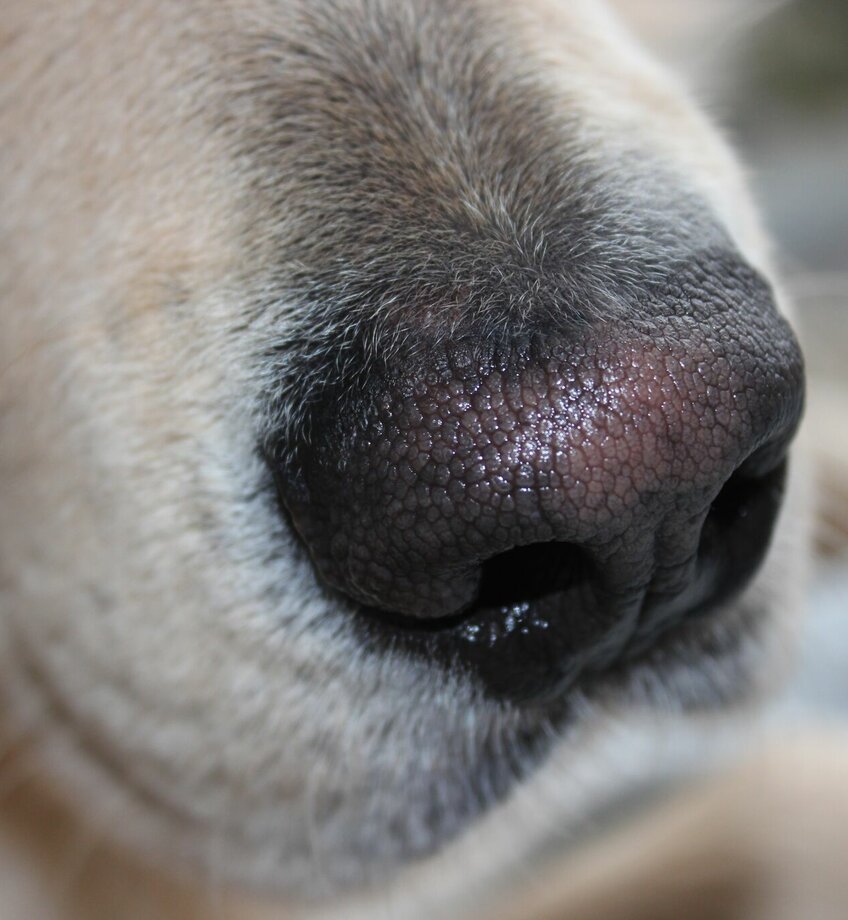
How Can Detection Dogs Help in the Fight Against African Swine Fever?
These reports are part of a broader study on the potential for using detection dogs to detect wild boar carcasses during an outbreak of African swine fever. Researchers: Hilde Vervaecke and Manon De Meester, Odisee; steering committee members: Uta Kielau (K9Hundenkunde), Ellen Van Krunkelsven (Quercus), Kristof Baert, and Arno Thomaes (INBO).
Logistics and operational aspects
Presentation on the use of detection dogs to locate wild boar carcasses as part of the fight against African swine fever. Belgian Wildlife Disease Society - October 2025, Geraardsbergen, INBO, Belgium.
Our students are researching detection dog practices
-
1
Anke De Moor. 2026. Sniffing Out Flatworms. An exploratory study on the feasibility of using detection dogs to detect invasive flatworms. Thesis in Agro- and Biotechnology, Animal Care specialization, Odisee 2025–2026. Advisor: Hilde Vervaecke, co-advisors: Ellen Van Krunkelsven, Jane Reniers
-
2
Indra Liekens. 2026. Dog Seeks Crayfish. Feasibility Analysis for the Detection of the Marble Crayfish (Procambarus virginalis). Thesis in Agro- and Biotechnology, Animal Care track, Odisee 2025–2026. Advisor: Hilde Vervaecke; co-advisors: Ellen Van Krunkelsven, Frédérique Steen, Bieke Maex.
-
3
Quintiens Tuur. 2025. A Nose for Ants. A study on the feasibility of using ecological detection dogs. Thesis in Agro- and Biotechnology, Animal Care track, Odisee 2024–2025. Advisor: Hilde Vervaecke, co-advisor: Wouter Dekoninck
-
4
Juna Coeck. 2024. To what depth can a detection dog detect the larvae of Lucanus cervus ? Thesis in Agro- and Biotechnology, Animal Care track 2023–2024, Odisee. Advisor: Hilde Vervaecke, co-advisor: Ellen Van Krunkelsven
-
5
Lien Geudens. 2024. Getxent as a scent carrier. An exploration of sniffing duration, the effect of impregnation time, and scent type. Thesis in Ago- and Biotechnology, Animal Care track 2023–2024, Odisee. Advisor: Hilde Vervaecke, co-advisor: Ellen Van Krunkelsven
-
6
Océane Marville. 2023. Can we use sensors to measure the sniffing duration of search dogs? Pilot project: evaluation of the SnuffelSensor. Thesis in Agro- and Biotechnology, Animal Care track 2022–2023, Odisee. Advisor: Hilde Vervaecke, co-advisor: Ellen Van Krunkelsven
-
7
Alicia Vorstenbosch. 2023. Sniffing Duration in Search Dogs: Does the evolutionary aversion to or attractiveness of a scent influence a dog’s sniffing duration?Thesis in Agro- and Biotechnology, Animal Care track, 2022–2023, Odisee. Advisor: Hilde Vervaecke, co-advisor: Ellen Van Krunkelsven
-
8
Wodan Libot. 2023. Measuring Olfactory Acuity in Detection Dogs.Thesis in Agro- and Biotechnology, Animal Care track, 2022–2023, Odisee. Advisor: Hilde Vervaecke, co-advisor: Ellen Van Krunkelsven
-
9
Brian Mommers. 2022. Ecological Search Dogs in Flanders. Evaluation of Data Collection.Thesis in Agro- and Biotechnology, Animal Care track, 2020–2021, Odisee. Advisor: Hilde Vervaecke, co-advisor: Eva Paridaens.
-
10
De Kort, Laura. 2020. Ecological Search Dogs: Needs and Future Plans. Thesis in Agro- and Biotechnology, Animal Care track, Odisee 2019–2020. Advisor: Hilde Vervaecke, co-advisor: Ellen Van Krunkelsven
About Wolves
Wolves—this is also a very sensitive issue for some dogs. Most dogs showed a strong aversion upon their first encounter with wolf droppings. Wietse, a Flat-Coated Retriever, was the least hesitant and was trained to become a wolf-droppings detection dog. Learn more about the pilot project.
Vervaecke, H., Van Krunkelsven, E., Van den Berge, K. (2021). Training of ecological detection dogs for wolf scat (Canis lupus). Bulletin of the University of Agricultural Sciences and Veterinary Medicine Cluj-Napoca, Animal Science and Biotechnologies, Vol. 78(1). Click here for the article. DOI: http://dx.doi.org/10.15835/buasvmcn-asb:2020.0021
Vervaecke, H., Van Krunkelsven, E., Van den Berge, K. (2020). Ecological detection dogs for wolf scat ( Canis lupus). Oral presentation at the 19th Online International Conference on Life Sciences for Sustainable Development. Sept. 24–25, Cluj-Napoca, Romania. Click here
Vervaecke, H. (2019). Ecological search dogs for wolf feces: proof of concept. Internal Report, Odisee University of Applied Sciences. Click here for the PDF.
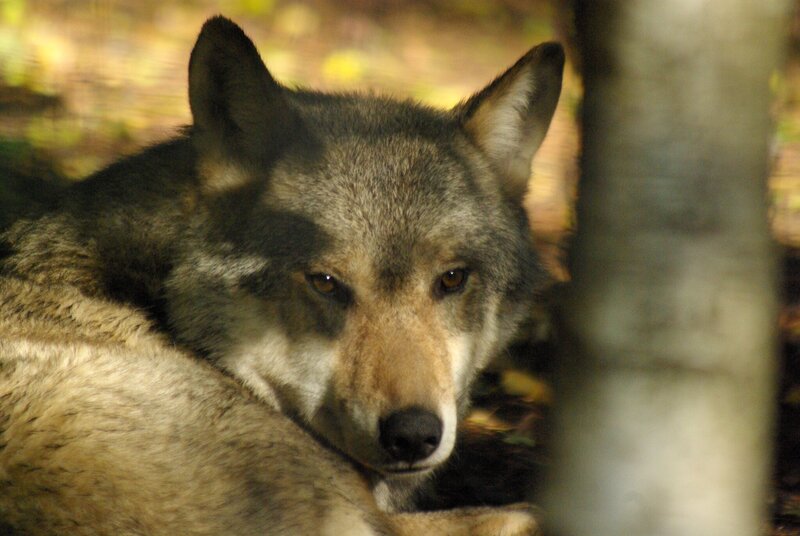
Vrijdag, K. (2021). The Use of Search Dogs in detecting wolvesand development of a certification method. Thesis in Agro- and Biotechnology, Animal Care track 2020–2021, Odisee. Advisor: Hilde Vervaecke, co-advisors: Ellen Van Krunkelsven & Carina De Pape. Shortlisted for the Flemish Thesis Prize. Click here.
In this bachelor’s thesis, Katrien Vrijdag investigated whether detection dogs can find wolf droppings. Various field tests, both indoors and outdoors, in controlled environments and in areas with wild wolves, demonstrated that detection dogs are more efficient than humans at detecting wolf droppings. The tests were critically evaluated to develop an optimal testing method for certifying a dog as an ecological detection dog for wolf droppings. Meanwhile, the dog Wietse has found numerous specimens that have yielded a wealth of scientific information about the diet and identity of the wolves in Flanders.
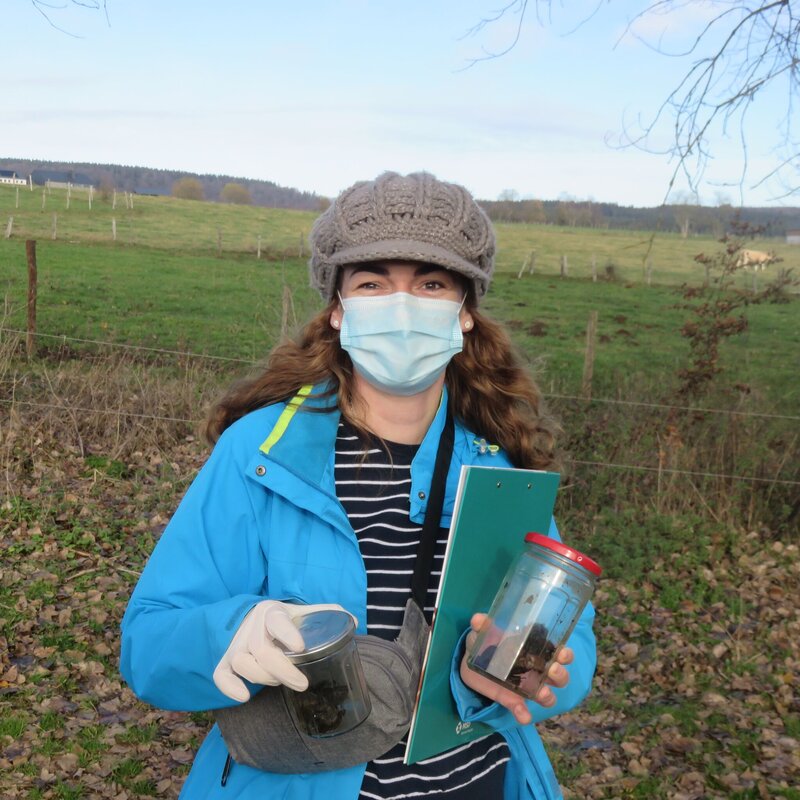
Technical aspects
Hilde Vervaecke, Océane Marville, Heidi Arnouts. 2023.Exploring Sniffing Durations: A Comparative Analysis of Detection Dogs and Scoring Types. Behaviour 2023 Conference. August 14–19, 2023. Bielefeld, Germany, Click here.

Stockmans, B., Thomaes, A., Van Krunkelsven, E., Vervaecke, H. (2019) Sniffing for nature. Detection dog training in a real-life environment. Fourth Natura 2000 Monitoring Workshop, April 9–11, 2019, Doñana, Spain. Click here for a PDF of the poster.
Winner, Shortlist, and Longlist for the Flemish Bachelor's Prize
Some of our students participated in the Flemish Thesis Prize:
Manon De Meester. (2022). Training Rats as detection animals. Detection of Mycobacterium avium subsp. paratuberculosis in goat colostrum. Bachelor’s thesis in Agricultural and Biotechnology, Animal Care track, 2020–2021, Odisee. Advisor: Hilde Vervaecke; co-advisors: Jo Vicca and Ellen Van Krunkelsven. Winner of the Best Bachelor’s Thesis Award at the Flemish Thesis Prize.
The bacterium ‘Mycobacterium avium subspecies paratuberculosis,’ or MAP for short, causes paratuberculosis in cows and goats. This highly contagious disease has a long incubation period of two to five years. The PCR test, which is used to detect the disease, is time-consuming and expensive for livestock farmers, meaning the disease often goes undetected. During her studies in Agricultural and Biotechnology, Manon De Meester investigated whether rats could detect the bacterium. For nearly a year, she trained four rats using samples of goat colostrum, and it worked! Vlekje, one of the rats, in particular, achieved impressive results with an accuracy rate of 92%. Manon won the Flemish Bachelor’s Prize for her thesis. Her thesis can be found here (Click here).

Vrijdag, K. (2021). The Use of Detection Dogs in detecting wolves and development of a certification method. Thesis in Agro- and Biotechnology, Animal Care track 2020–2021, Odisee. Advisor: Hilde Vervaecke, co-advisors: Ellen Van Krunkelsven & Carina De Pape. Shortlisted for the Flemish Thesis Prize. Click here.
In this bachelor’s thesis, Katrien Vrijdag investigated whether detection dogs can locate wolf droppings. Various field tests, both indoors and outdoors, in controlled environments and in areas with wild wolves, demonstrated that search dogs are more efficient than humans at detecting wolf droppings. The tests were critically evaluated to develop an optimal testing method that would allow a dog to be certified as an ecological detection dog for wolf droppings. Meanwhile, the search dog Wietse has found numerous specimens that have yielded a wealth of scientific information about the diet and identity of the wolves in Flanders.
Stockmans, B. (2019): Training ecological search dog teams. Obstacles and success factors in the INBO project. Thesis in Agro- and Biotechnology, Animal Care track, Odisee 2018–2019. Advisor: Hilde Vervaecke, co-advisor: Ellen Van Krunkelsven. Longlisted for the Flemish Bachelor’s Prize. Click here.
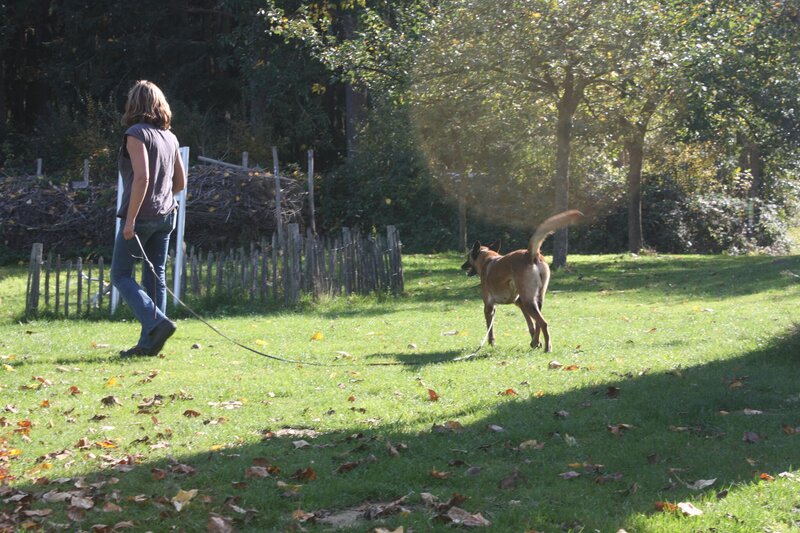
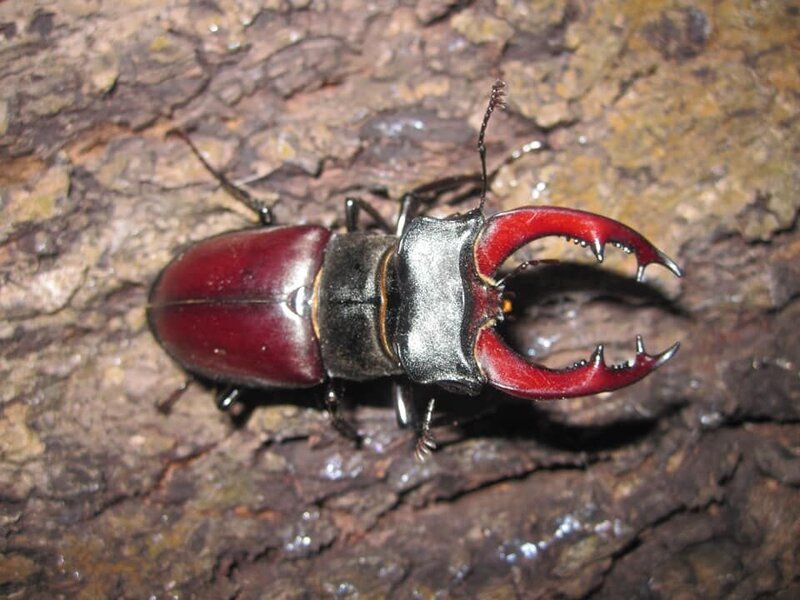
Terpelle, I. (2016). The use of dogs to detect Lucanus cervus larvae (third prize in the Flemish Thesis Prize). Thesis in Agro- and Biotechnology, Animal Care track, 2015–2016, Odisee. Advisor: Hilde Vervaecke, co-advisor: Ellen Van Krunkelsven. Third place in the Flemish Thesis Prize. Click here.
Detection Dogs in the Police and the Military
Andes Prado Hernandez. 2024. Sniffing Laterality in Trained Detection Dogs of the Federal Police. Thesis in Agro- and Biotechnology, Animal Care track, Odisee 2023–2024. Advisor: Hilde Vervaecke; Co-advisor: Bart Meeus.
Sniffing on the Left or Right
Recent research on sniffing laterality shows that nostril use can vary depending on the emotional value of a particular scent. Whether a dog sniffs with its left nostril, right nostril, or both may therefore provide useful insights into how search dogs emotionally perceive scents. Andes Prado Hernandez investigated this in trained detection dogs from the Federal Police. She tested six dogs by having them sniff sterile cotton swabs impregnated with various scents (wolf feces, horse manure, thyme, dog kibble, dried duck, odorless, lemon). The dogs stuck their noses into a tube, and their sniffing behavior was recorded with video cameras. After each scent presentation, the cotton swabs were replaced to maintain scent consistency. The findings showed that the dogs’ initial sniffing behavior was predominantly centered in the middle before shifting toward the left or right nostril. There was individual variation in laterality, but no clear link to specific odors. The literature revealed how complex the organization of sensory lateralization is and how much our understanding of it is still in its early stages.

Iliana Van Hauwermeiren. 2024. Odor Generalization in the Training of Explosives Detection Dogs. Thesis in Agro- and Biotechnology, Animal Care track, Odisee 2023–2024. Advisor: Hilde Vervaecke; Co-advisors: Marc Weynants, Leopold Moriau.
Olfactory Generalization in the Training of Explosive Detection Dogs
Iliana Van Hauwermeiren monitored four dogs during their training to detect explosives. The goal of this study was to determine whether the dogs could learn to generalize a specific odor component. To this end, Iliana observed their training, their progress, and how they performed on a final test. If the entire process were successful, the sequence of steps used in standard training could be optimized. Iliana observed the dogs at various locations during the different phases of training and testing. The goal was achieved, and the dogs successfully learned to generalize the scent. It was impressive for her to gain insight into the trainers’ wealth of practical experience and the dogs’ learning process. The dogs are now working in a war zone.

Manon Stroobant. 2024. The Limits of a Dog’s Sense of Smell. The Effect of Packaging on the Detectability of Explosives by Detection Dogs. Thesis in Agro- and Biotechnology, Animal Care track, Odisee 2023–2024. Advisor: Hilde Vervaecke; Co-advisors: Sven Muës & Bjorn Noyez.
The Limits of the Sniffer’s Nose. The Effect of Packaging on the Detectability of Explosives by Detection Dogs.
Manon Stroobant studied the influence of various packaging materials on the effectiveness of explosive detection dogs (EDDs). She examined the detection capabilities of dogs with four types of packaging: plastic containers, metal containers, vacuum-sealed packaging, and dry ice. The findings may contribute to optimizing the training and deployment
of EDDs in security operations.